Brand-Owned Agent: What It Is and How It Specializes in Your Company
A Brand-Owned Agent is an AI agent that knows a company's catalog, offers, and customer questions, and helps people make decisions. Learn how it works, see real-world examples, explore key considerations, and find out how to get started.


A Brand-Owned Agent is an artificial intelligence agent specialized in a company. It knows the company's catalog, portfolio, commercial offers, differentiators, and frequently asked questions. It talks with customers in natural language and helps them make decisions: it understands the context, answers questions, compares alternatives, and solves problems, always within the brand's world. In practice, customers replace scrolling through pages with prompts.
The habit has already changed. Adobe measured that traffic from generative AI tools to retail websites in the United States grew 693.4% between November 1 and December 31, 2025, compared with the same period the previous year (Adobe). People who have gotten used to asking ChatGPT or Gemini questions expect to be able to ask questions when they reach a website, too. That's one reason the website has become a company's most strategic asset in the age of AI.
What can a Brand-Owned Agent do that a website alone can't?
A traditional website organizes information the way the company envisioned it, and customers navigate menus and filters until they find what they need. A Brand-Owned Agent flips that logic: customers describe their situation, and the agent puts together an answer.
In a single conversation, it can handle:
- Catalog and portfolio. "Which of these models works for a small kitchen?" The agent filters, explains, and shows only the options that make sense.
- Commercial offers. Terms, timelines, shipping, plans, and what's included in each one.
- Differentiators. Why choose this product over another, with arguments based on what the brand actually delivers.
- Recommendations. Combinations, accessories, and the next step after purchase.
- Frequently asked questions. Returns, warranties, installation, use, and support.
Unlike a fixed-script chatbot, the agent understands questions no one anticipated and chooses which information and tools to use to answer them. We explore this difference in detail in our article on AI agents and chatbots.
How does a Brand-Owned Agent work under the hood?
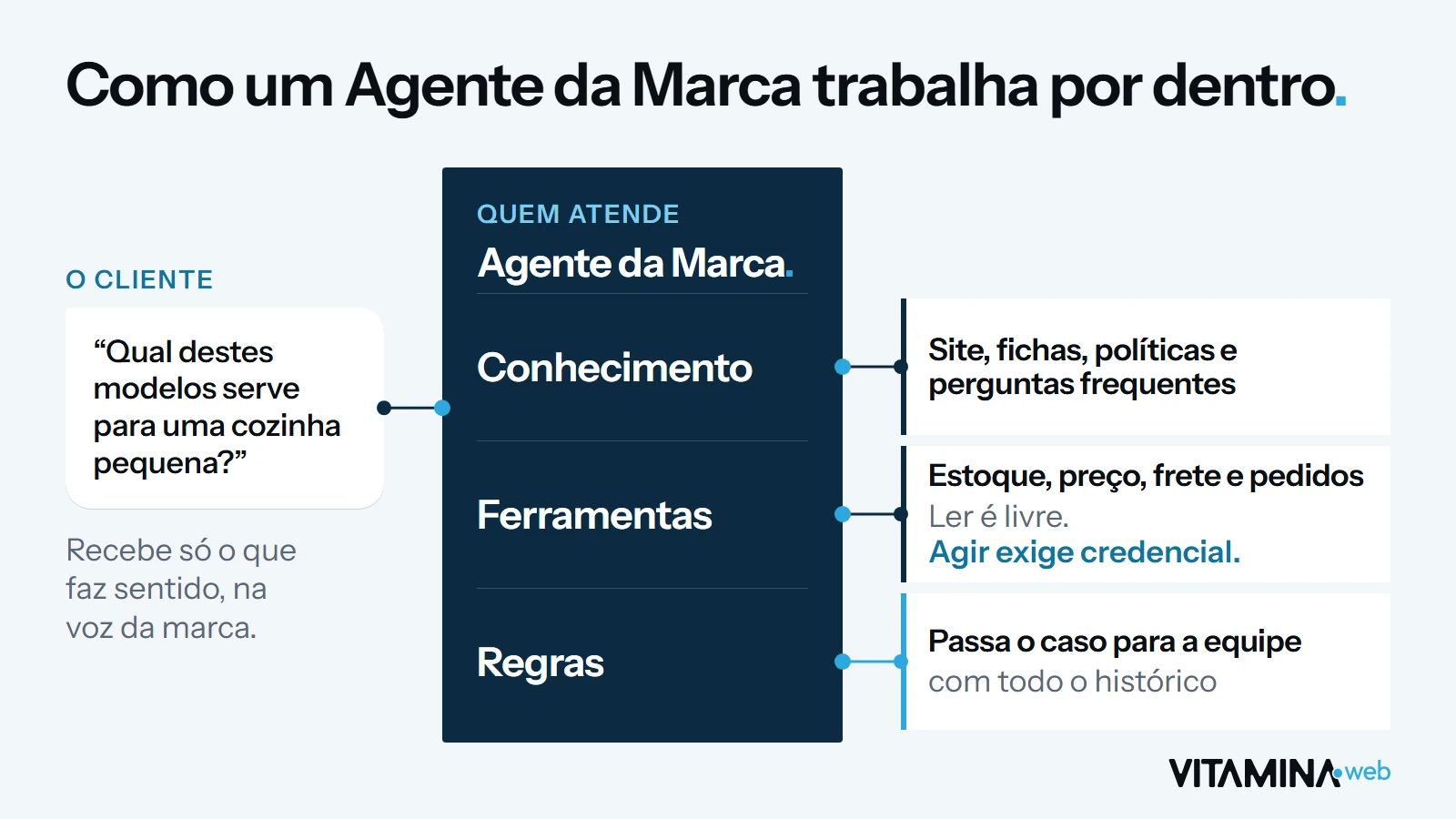
Three components support a Brand-Owned Agent: knowledge, tools, and rules.
Knowledge: where the agent's knowledge comes from
The model provides the ability to converse. What it knows about the brand comes from elsewhere: website pages, product sheets, commercial policies, frequently asked questions, manuals, and customer service history. The most widely used technique for this is RAG, retrieval-augmented generation: before answering, the agent searches this knowledge base for relevant passages and writes its response based on them, preferably citing the source. That's what we do in our RAG agent projects.
That's why a Brand-Owned Agent is only as good as the content that feeds it. If the price on the website is out of date, the agent will repeat the wrong price with complete confidence. Amazon itself says its shopping assistant draws on its catalog, customer reviews, community questions and answers, and information from other websites (Amazon).
Tools: when the agent looks things up and takes action
To go beyond conversation, the agent needs access to systems: inventory, pricing, shipping, order status, scheduling, CRM. This happens through APIs and MCP (Model Context Protocol), an open standard that connects AI assistants to a company's tools without requiring a different integration for each assistant. That's the work involved in integrating APIs and systems.
It's worth distinguishing between reading and taking action. Checking inventory or calculating shipping costs carries little risk. Creating an order, booking an appointment, or opening a support ticket on someone's behalf requires authentication and stricter rules. For example, the MCP server on the VitaminaWeb website lets any agent search and read content, but requires credentials to open a sales inquiry on someone's behalf (server card).
Rules: boundaries and handing off to a human
A good Brand-Owned Agent knows what it shouldn't do. It doesn't promise discounts that don't exist, stray beyond the brand's scope, or pretend to know something when it doesn't. It also recognizes when a conversation needs a person, such as in a sensitive complaint or a negotiation outside company policy, and hands it off to the team with the conversation history, so the customer doesn't have to repeat everything. This is at the heart of AI-powered customer service projects.
Is a Brand-Owned Agent the same as a customer's ChatGPT or Gemini?
No, and the difference changes the strategy. The customer's assistant, whether ChatGPT, Gemini, or Gemini's automatic browsing in Chrome, works for the consumer. It researches multiple brands, compares them, and puts together a shortlist. When it visits your website, it's just another visitor, reading the code instead of looking at the storefront. A Brand-Owned Agent works on the company's side: it knows everything about the company, speaks in its voice, and follows its rules.
The two approaches complement each other. The customer's assistant needs clear information on your website to recommend you, a topic covered in our guide on how to prepare your website to be read and used by AI agents. The Brand-Owned Agent uses that same knowledge base to assist people who have already arrived. Google opened this path in its own search engine: in January 2026, it launched Business Agent, which it describes as a virtual salesperson that can answer product questions in a brand's voice, starting with US retailers like Lowe's and Reebok (Google). And some brands are already bringing their own agent into the customer's assistant.
Which brands already have their own agents?
Walmart: Sparky and the checkout lesson
Walmart tested completing purchases inside ChatGPT. According to Daniel Danker, the company's executive vice president of design and product, in an interview with WIRED, purchases completed inside the chat converted at about one-third the rate of purchases where customers continued to Walmart's website (PPC Land, based on WIRED).
The response was to bring Sparky, the retailer's own assistant, into ChatGPT. Since March 2026, the conversation starts in the chat and moves to a Walmart environment, where account linking, the loyalty program, and payment take place (Retail Dive). In January, the company had already announced a Gemini experience with Google, also with purchases completed at Walmart checkout (Retail Dive).
Amazon: from Rufus to Alexa for Shopping
Amazon reported in November 2025 that more than 250 million customers had used Rufus, its shopping assistant, that year. It also said that among customers who use the assistant while shopping, the likelihood of making a purchase during that visit is more than 60% higher (Amazon). In May 2026, Rufus was renamed Alexa for Shopping (Amazon).
Magalu: Lu sells through WhatsApp
In Brazil, Magalu turned Lu into a salesperson on WhatsApp. Launched in late October 2025 (Mobile Time), the feature provides access to its own catalog and that of marketplace partner sellers, and accepts Pix or card payments right in the conversation (TI Inside). In a WhatsApp Business case study, using data provided by the company for the period from October 21 to December 3, 2025, conversion was three times higher than in the Magalu app and website (WhatsApp Business).
All three cases point in the same direction: a brand's agent, using the brand's data, brings the decision into an environment the brand controls.
What precautions does a Brand-Owned Agent require?
Accurate information
The agent speaks on behalf of the company, and the company is responsible for wrong answers. Use official sources for responses, keep the knowledge base up to date, and review conversations, starting with questions that went unanswered.
Prompt injection
Prompt injection is an attempt to hide malicious instructions in something the agent reads, such as a webpage, email, or document. OpenAI said in December 2025 that this kind of attack, like scams targeting people online, is unlikely to ever be completely eliminated (OpenAI). Defenses need to be built into your system: treat external content as data, never as instructions, give the agent only the tools it needs, require authorization for any action, and log everything it does.
Human confirmation at checkout
Chrome Help lists "completing a purchase or placing an order without your permission" among the possible errors of automatic browsing with Gemini (Google). You don't control the assistant your customer uses. That's why confirmation needs to happen at your checkout: a clear order summary, the final price displayed, and an explicit acceptance step before any charge.
LGPD
The LGPD requires a defined purpose, collecting only what's necessary, and transparency. It also guarantees data subjects the right to request a review of decisions made solely through automated processing. In practice, that means telling customers they're talking to AI, asking only for the data needed to provide assistance, not reusing conversations for another purpose without informing them, and keeping a path to a human available.
How do you get started with a Brand-Owned Agent at your company?
- Choose a narrow use case. Questions that come up repeatedly and have known answers: product selection, commercial terms, delivery times, returns.
- Organize your knowledge base. Complete and consistent website content, product sheets, policies, and FAQs. This is the same work that prepares your site for external agents.
- Start by reading, then move to action. First, the agent looks up information and answers questions. Requests and bookings come later, once authentication and rules have been tested, as in our AI agent projects.
- Set limits and escalation paths. Specify what the agent cannot do and when it should bring in a person.
- Measure what matters. Resolutions without escalation, conversions, satisfaction, and unanswered questions, which show what your content is missing.
Frequently asked questions
What is a Brand-Owned Agent?
It is an AI agent that specializes in a company. It knows the catalog, portfolio, offers, differentiators, and FAQs, communicates in natural language, and helps customers make decisions within the brand’s world.
Does a Brand-Owned Agent replace human customer service?
No. It handles repetitive questions and prepares cases for the team, which focuses on matters that require judgment, negotiation, or empathy.
Do I need an e-commerce store to have a Brand-Owned Agent?
No. Service companies, manufacturers, and B2B brands also have portfolios, commercial terms, and FAQs. The agent can qualify leads and forward them to the sales team.
Will a Brand-Owned Agent make my brand appear in ChatGPT?
Not directly. Appearing in assistants’ answers depends on clear content, reputation, and a presence in trusted sources, the work of SEO and GEO. But the knowledge base that powers the Brand-Owned Agent is the same one that helps assistants understand your business.
What to do next
A Brand-Owned Agent starts with the content your company already has and the way your website organizes it. If you’d like to find out what the first use case might be for your business and what needs to be ready beforehand, talk to VitaminaWeb.