In the AI era, the website is once again a company’s most strategic asset
AI systems assemble answers and recommendations from what they read, and the website is the source the company controls. See how its role is changing and where to start.


In the AI era, the website has once again become a company’s most strategic asset because assistants get much of what they say about a brand from it. When someone asks ChatGPT, Gemini or Perplexity to recommend a supplier, product or service, the answer is assembled from what these systems can read, and the website is the only source the company fully controls. A new type of visitor has also started to arrive: the AI agent that researches, compares and acts on someone’s behalf. For this visitor, the website stops being a storefront and becomes an information source and a point of contact.
For years, many companies treated their website as a business card and put their energy into social media, marketplaces and ads. It is time to rethink that equation.
Why has the website returned to the center of digital strategy?
The internet has gone through three stages in a short time, and each one changes what a website needs to do.
The search engine that indexes. The model everyone knows: Google reads pages, organizes a list of links, and companies compete for rankings and clicks.
The ready-made answer. Then came AI-generated summaries at the top of search results and assistants that answer directly. People no longer need to visit a website to get the basics. A Pew Research Center study using browsing data from 900 adults in the United States in March 2025 found that people who see an AI summary click on a traditional link in 8% of visits, compared with 15% of those who do not.
The agent that acts. Now the assistant researches, decides and carries out a task for someone: it puts together a list of options, checks prices and timelines, or fills out a form. Cloudflare, which operates one of the internet’s largest networks, reported in September 2026 that daily AI agent requests on its network grew by more than 1,700% in a year, and that this year, for the first time, more than half of internet traffic was non-human.
In all three stages, whoever answers needs a source. And that is where the website carries more weight again.
The only channel the company controls
On social media, the algorithm decides who sees what. On a marketplace, the platform sets the rules, the storefront and the commission. With paid media, reach lasts only as long as the budget does. The website is the only place where a company chooses what to say, how to say it and how much detail to provide. It is an owned channel by definition.
This difference has always existed, but it has become more costly. When an AI needs to explain what your company does, how much it costs or who it is for, it looks for a source that answers clearly. If your website does not answer, it turns to another source, which may be outdated, belong to a competitor or be wrong.
Where AI gets the signals it uses to recommend brands
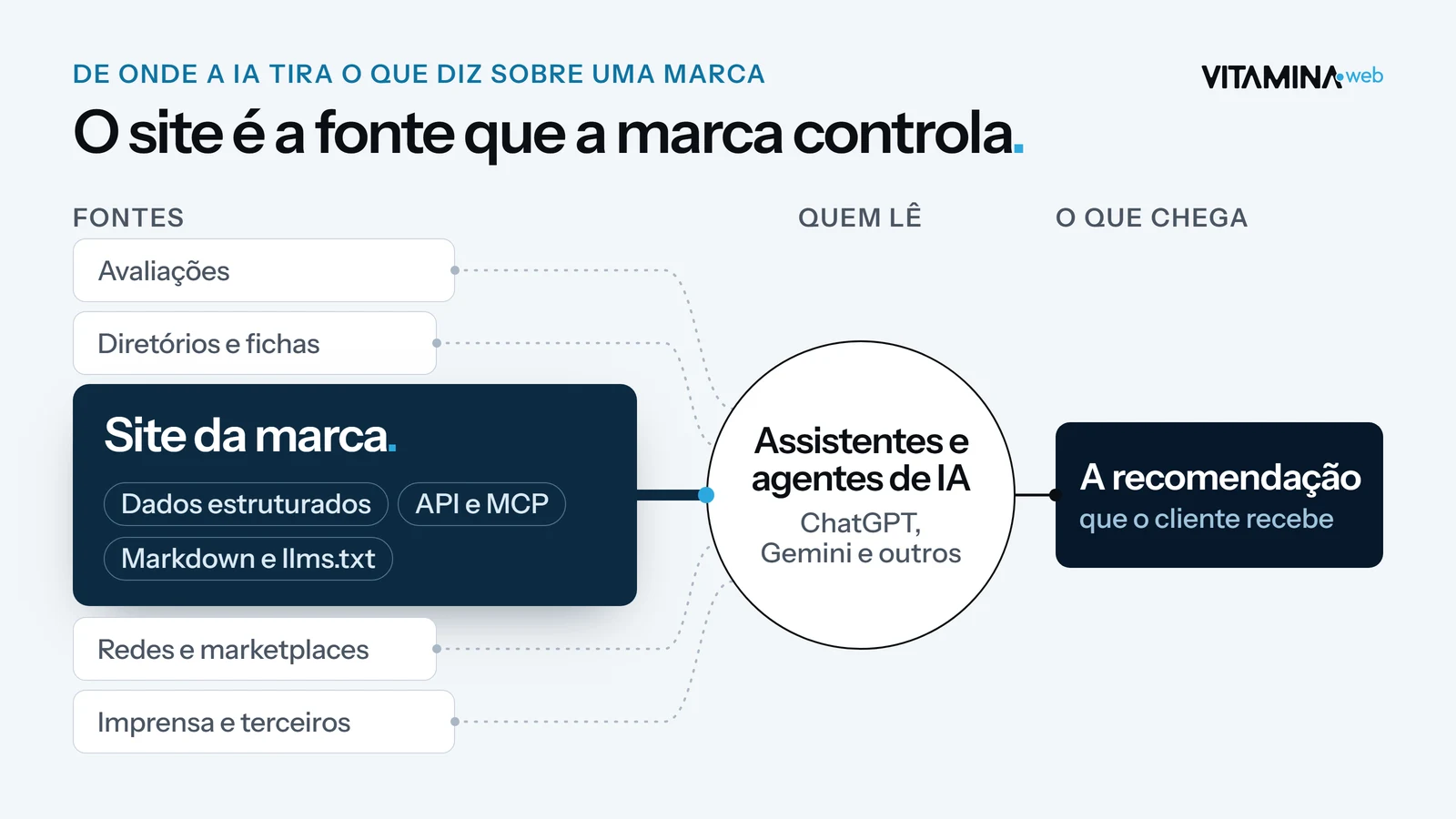
No one outside these companies knows the exact weights each model uses to decide what to cite. But we can measure the final result. Yext, a company that works in digital presence management, analyzed 6.8 million citations made by ChatGPT, Gemini and Perplexity between July and August 2025. According to the study announcement, 86% came from sources the brand controls or influences, such as its website, directory listings and reviews. Company websites made up the largest share, at 44%. A later study by the same company, analyzing 155.5 million citations from four models in the first quarter of 2026, showed that 80% pointed to the brand’s website or those listings, sources the company itself can keep up to date.
These studies come from a company that sells this service, and the questions analyzed take the searcher’s location into account. Still, the findings line up with what we see in our projects: what AI says about a brand depends a great deal on what the brand publishes about itself.
Are visitors coming through AI more valuable than ordinary visitors?
The available data suggests they are. According to Adobe Analytics, figures on US retail published in August 2026 by Digital Commerce 360 show that visits from AI assistants convert at a rate 60% higher than the rest of the traffic. People arriving through AI have already compared and filtered their options, and often have already decided.
In Brazil, behavior is following the same trend. The Global Payments Agentic Commerce Report 2026 found that the share of Brazilians who have used, or are willing to let, an AI agent make a purchase on their behalf rose from 39% to 72% in one year. In Mercado Pago’s Panorama de Consumo 2026, based on 3,345 Mercado Livre and Mercado Pago users, 54% said they intend to use an AI feature to choose products, up from 48% in 2025.
This does not mean a company needs to rush to sell through ChatGPT. Walmart’s case helps put things in perspective. The retailer tested completing purchases inside ChatGPT, and conversion was three times lower than when customers went to Walmart’s website. The company changed its strategy: it brought its own assistant, Sparky, into ChatGPT, with sign-in and payment handled in Walmart’s system.
The lesson applies to companies of any size: today’s goal is to make the assistant’s shortlist. The sale can still happen on your website.
How is the website’s role changing?
The website is still for people. No one needs to give up on design, branding or user experience. What changes is that it now has two more readers, each with different needs.
From storefront to source
People see the page as it is presented, with photos, animation and menus. An agent receives the code behind all of it, where important information is often hidden in scripts, closed tabs or images without text. If it cannot find prices, timelines, coverage and differentiators in clear text, it is likely to skip the page or fill in the gaps with what it found elsewhere.
Being a source means publishing in a way machines can understand without effort: text content, structured data and a streamlined version of the page for anyone who asks. Here is an example from our own site: VitaminaWeb’s AI agents page is about 114 KB in HTML. When an agent requests the same page in markdown, it receives about 3 KB with the same content. Less to read, lower processing costs and less chance of the agent getting lost along the way.
This is also the work of SEO and GEO: helping a brand get found in search and cited in answers. We explain this competition in more detail in GEO and AI agents and in our article about fan-out, which shows how one question turns into dozens of searches behind the answer.
From source to interface for agents
The next step is letting the agent do something, not just read. Open standards make this possible. The best-known is MCP (Model Context Protocol), created by Anthropic and donated in December 2025 to the Agentic AI Foundation, affiliated with the Linux Foundation, whose founding members include OpenAI, Google and Microsoft. With MCP, a company publishes a server with tools, such as searching a catalog, checking availability or submitting a quote request, and any compatible assistant can use them.
Almost no one has done this yet. When Cloudflare analyzed the world’s 200,000 most visited domains in April 2026, it found fewer than 15 websites publishing an MCP server card or an API catalog. Companies that act now can get ahead of much larger competitors.
There is no need to start with purchases. Read-only tools, such as searching a catalog or answering questions, are low-risk and already put the company in the agent’s conversation. Orders, appointments or contact can come later, with authorization and confirmation. When a company already has systems in place, integrating APIs and systems is what connects the MCP server to inventory, CRM or a calendar.
And where does the Brand-Owned Agent fit in?
If the website becomes a source for other companies’ assistants, the natural next step is for the brand to have its own assistant. That is what we call a Brand-Owned Agent: an AI agent that specializes in a single brand, trained on that company’s catalog, portfolio, offers, differentiators and frequently asked questions. Instead of scrolling through pages, customers ask questions. The agent understands the context, compares options within the portfolio and helps them decide, always within that brand’s world.
In January 2026, Google announced Business Agent, which it describes as a virtual sales assistant that can answer questions about products in the brand’s voice, right in search. In May, it introduced a version for ads in AI Mode, where people can click to chat and receive answers based on the advertiser’s website.
Notice the detail: even Google’s virtual sales assistant answers based on the website. A Brand-Owned Agent is only as good as the source that powers it. We explain the concept, use cases and considerations in Brand-Owned Agent: what is an AI agent that specializes in your company?
Where should a company start?
Order matters. In the Marketing for Machines talk that Rodrigo Neves, CEO of VitaminaWeb, gave at Conexion SP 2026, we organized the path into four layers, from the least expensive to the most valuable.
- Be readable. Text content, structured data on product and service pages, a markdown version, and an llms.txt file that introduces the site to agents. You can get started without a new budget.
- Stay in control. Specify in robots.txt what each bot can do with your content: appear in search results, be used in answers, or be used to train models. And know who is visiting.
- Enable action. A public API and MCP server, starting with read-only tools and moving on to actions with authorization.
- Ensure trust. Human confirmation before any commitment, scope-based permissions, a record of what was done, and protection against prompt injection, which is a malicious instruction hidden in something the agent reads.
A simple test can help you decide where to start: ask ChatGPT and Gemini what your company does, how much it charges, and who it serves. What they get wrong about you shows what your site still isn't explaining clearly.
The technical step-by-step guide, with code examples and a checklist, is available at How to prepare your site to be read and used by AI agents. If your team wants a snapshot of the current situation before making a decision, a digital assessment can show where the gaps are.
How did VitaminaWeb apply this to its own site?
Before making recommendations, we put it into practice ourselves. The site was rebuilt for four kinds of readers: people, search engines, assistants, and agents.
Each page has a markdown version, provided when an agent requests it. The llms.txt introduces the company, its services, and its content. The public API delivers blog articles in a structured format. The robots.txt deliberately allows the content to be used in search, AI answers, and model training, because we want the brand to be present wherever decisions are made.
The site also has a public MCP server with five tools: search for content, read an entire piece of content, request a resource, subscribe to the newsletter, and start a sales conversation. The read-only tools work for any agent. Tools that act on behalf of a person require OAuth authorization, and the returned content is marked with a warning telling the agent not to follow instructions contained within it.
On Cloudflare's Is It Agent Ready scanner, which evaluates sites on a scale from 0 to 5, vitaminaweb.digital is at level 5, Agent-Native, the highest level, in the scan run on November 28, 2026. We showed this at Conexion to prove it can be done today, using existing standards.
Frequently asked questions
Does the website become less important if people stop clicking?
No. It may get fewer clicks, but it becomes more important as a source. Even when someone doesn't visit, the answer they receive is built from what the site has published. And people who click after talking to AI arrive further along in their decision.
Do I need to rebuild my site so AI agents can read it?
In most cases, no. Text content, structured data, a markdown version, llms.txt, and clear rules in robots.txt can be added to your existing site. A rebuild is only necessary when the technology doesn't support these layers.
What is a Brand-Owned Agent?
It's an AI agent that specializes in a single brand, knows its catalog, offers, differentiators, and frequently asked questions, and talks with customers to help them make a decision. It relies on a well-structured site to answer accurately.
Do small and medium-sized businesses need to worry about this too?
Yes, and they may have more to gain. Since few sites are prepared, a smaller company that gets the basics right can make an assistant's shortlist ahead of larger competitors.
Shall we talk about your website?
If you want to understand how your site appears to search engines, assistants, and agents, and what would make sense to change first, we can take a look together. Sometimes the answer is a small update to your existing corporate website, and sometimes it's a larger project. Get in touch with VitaminaWeb and tell us where your company is today.