How to Prepare Your Website to Be Read and Used by AI Agents
A four-layer guide for marketers: make your website readable to machines, control what bots can do, let agents act through APIs and MCP, and ensure they can act without putting the business at risk.


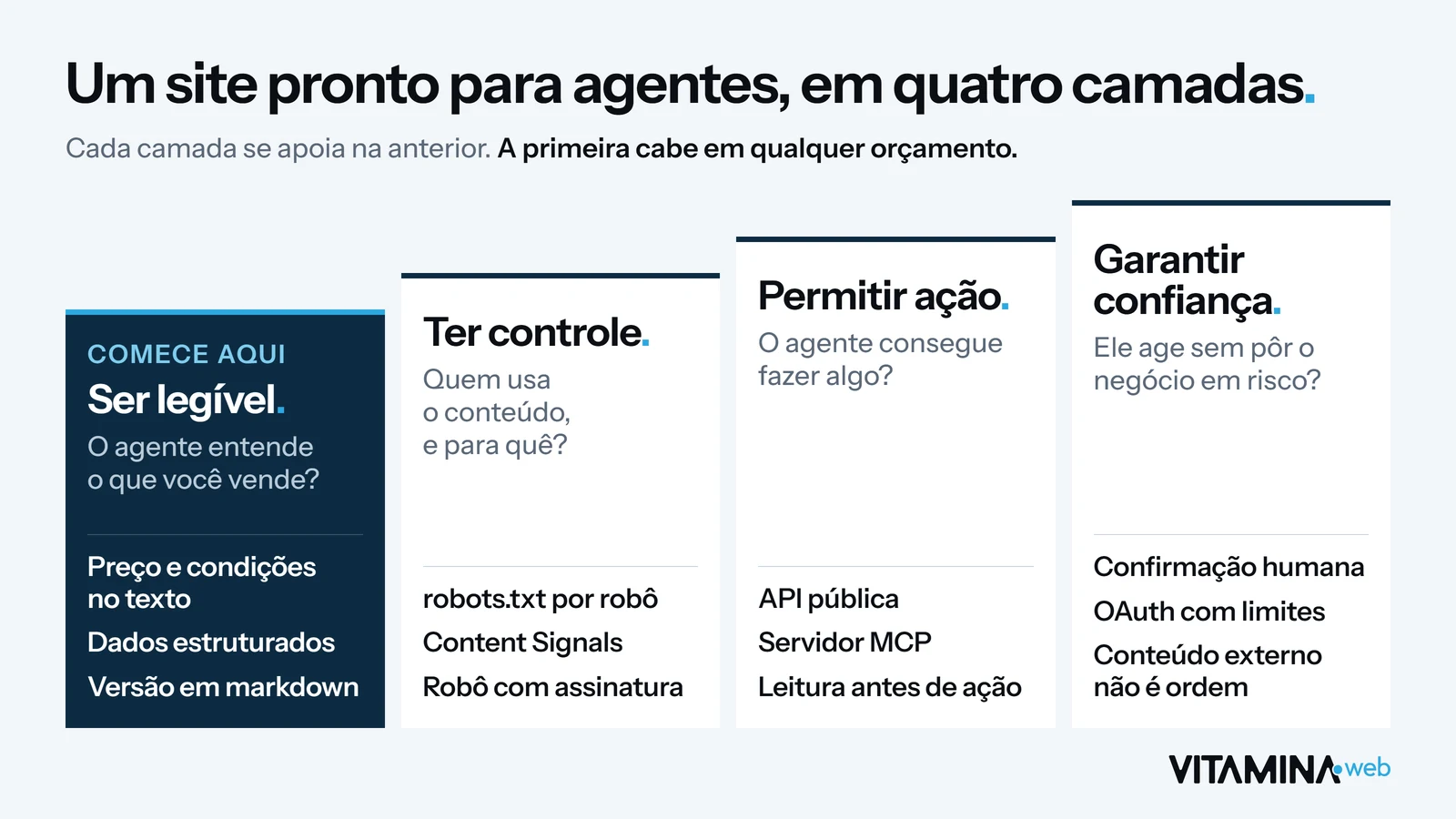
To prepare your website for AI agents, work through four layers, in this order: make it readable (content machines can understand), set controls (what each bot can do with it), enable action (a way for the agent to query and act), and ensure trust (the rules that protect those actions). The first layer fits any company’s budget. The others depend on how much your business gains when an agent can query, compare, and route a purchase without opening a page.
That was the roadmap for the talk "Marketing for Machines: From Indexing to Action," presented by Rodrigo Neves, CEO of VitaminaWeb, at Conexion SP 2026. Here, it becomes a practical guide for marketers. The reasoning behind it is in the article about the website as a strategic asset in the AI era, and the agents that turn that website into a consulting resource are covered in what a Brand-Owned Agent is.
Why get ready now, when almost no one has?
That’s exactly why. In April 2026, Cloudflare analyzed the 200,000 most visited domains on the internet. According to the Agent Readiness study, only 3.9% serve a page in markdown when an agent requests it, and 4% declare in robots.txt what AI can do with their content. MCP server cards and API catalogs combined appear on fewer than 15 sites across the entire dataset.
The bar is low. Companies that get the basics right today will be ahead of many large businesses.
Make it readable: can the agent understand what you sell?
A person sees the storefront. The agent gets the page code, with the menu, scripts, and footer mixed in with what matters. If the price only appears after JavaScript runs, or the delivery time is inside an image, the agent may not see it. And if it doesn’t understand what you offer, nothing else matters.
Important information in the HTML
Prices, terms, delivery times, warranties, returns, and differentiators need to be in the page text, loaded along with it, and answer the questions customers actually ask. It’s the same care that already helps with SEO, now for one more reader.
Structured data (JSON-LD)
Structured data is a block of code, invisible to visitors, that describes the page using the standard Schema.org vocabulary: this is a company, this is a product, this is the price.
Google is clear about its scope. In its guide to optimizing for AI features in Search, it says structured data isn’t required to appear in AI features and there’s no special markup for them, but recommends continuing to use it because it makes a page eligible for rich results. In practice, it’s the cheapest way to state a fact unambiguously, as long as the JSON-LD exactly matches what’s written on the page.
Markdown versions of your pages
Markdown is clean text, with only headings, lists, and links. When an agent requests the page in this format (using the Accept: text/markdown header), it gets the content without the weight of the layout. When Cloudflare launched Markdown for Agents, it showed that a post on its own blog uses 16,180 tokens in HTML and 3,150 in markdown, about 80% fewer.
On the VitaminaWeb website, the AI agents page weighs 114 KB in HTML and 3 KB in markdown, based on a measurement we took on November 28, 2026. The same content, 97% smaller: lower costs for those running the agent and less chance of it getting lost.
llms.txt: what it does and what it doesn’t
llms.txt is a file at the root of a website that works as a markdown map for language models. It has become popular, so it’s worth setting expectations. Ahrefs analyzed 137,000 domains with traffic in May 2026. Of the roughly 38,000 with a valid llms.txt, 97% received no requests for the file that month, from either people or bots. In the same guide cited above, Google says Search doesn’t use this file and creating one doesn’t help or hurt visibility on Google.
Our take: llms.txt is inexpensive and can serve as an index for agents that look for it, but it’s not what gets your brand into the answer.
AI mistakes about your company are a diagnostic tool
Ask ChatGPT, Gemini, and Perplexity what your company does, how much it costs, and who it’s for. Every incorrect answer points to a page that doesn’t explain that clearly.
Set controls: who can use your content, and for what?
Not every bot that visits your website gives you something in return. Some index pages for Search, others find snippets for an answer, and others collect text to train models. OpenAI documents a bot for each use case: GPTBot for training, OAI-SearchBot for ChatGPT Search, and ChatGPT-User for visits requested by a person, which may not follow robots.txt. At Google, Google-Extended controls the use of content for training and Gemini responses, without affecting a site’s presence or position in Search.
To state this directly, Cloudflare proposed the Content Signals Policy, with three signals in robots.txt: search (appear in search results), ai-input (be used to generate an AI response), and ai-train (train models). A brand that wants to be cited but would rather not contribute to training would write:
User-agent: *
Content-Signal: search=yes, ai-input=yes, ai-train=no
Allow: /
This is a statement of intent, and compliance is voluntary: Cloudflare itself warns that some bots will simply ignore it. That makes the next step knowing which bot is visiting. With Web Bot Auth, a Cloudflare proposal under discussion at the IETF, the bot signs each request cryptographically and the website verifies who is on the other end before granting access. The decision depends on the business: for companies selling products or services, appearing in answers is usually worth more than protecting the text; for publishers, the calculation is different.
Enable action: can the agent do anything on your website?
The website is the storefront. The API is the counter. The agent doesn’t need to click a button: it asks and gets an exact answer.
Public API
An API is a data gateway with clear rules: the agent asks, "what is the price of this item for this ZIP code?" and gets the answer right away. Many companies already have internal APIs; the work is deciding what can be opened up, documenting it, and protecting it. This is the kind of project we do through API and systems integration.
MCP: one plug for every AI
Previously, each assistant needed its own integration with every system. MCP (Model Context Protocol) works like a standard plug: a company writes a server once, and any compatible assistant can connect to it.
Created by Anthropic, the protocol moved in December 2025 to the Agentic AI Foundation, affiliated with the Linux Foundation. According to the foundation’s announcement, MCP already had more than 10,000 published servers and was being adopted by Claude, ChatGPT, Gemini, Microsoft Copilot, Cursor, and VS Code. In Brazil, Mercado Livre publishes an official MCP server for developers building integrations with the platform, with login through OAuth.
Start with read-only tools
Read-only tools only query: search for a product, check inventory, calculate shipping, check a calendar, or see an order’s status. The risk is low, and they already put your company in the agent’s conversation. Placing an order, signing up, or canceling comes later, with trust rules in place.
The VitaminaWeb MCP server at vitaminaweb.digital/mcp follows this approach: searching and reading content is open; requesting materials, opening a sales contact, or subscribing to the newsletter requires a token obtained through OAuth on behalf of the person.
Ensure trust: how can you let the agent act without putting the business at risk?
This is the layer that separates an experiment from a business.
Human confirmation needs to be built into your system
You don’t control the assistant your customer uses. The Gemini in Chrome help page itself lists completing a purchase without the user’s permission among the possible errors of automated browsing, and warns that the user is responsible for the agent’s actions, including purchases. If the assurance isn’t provided on the other end, it needs to come from your side: paying, canceling, or deleting should require a person’s confirmation in your checkout.
Identity, limits, and audit trail
The agent acts on behalf of an identified customer, who logs in through OAuth. Each permission has the minimum required scope, because reading isn’t the same as buying. There are limits on the value and number of requests per customer, and every request is logged.
Defense against prompt injection
Prompt injection is an instruction hidden in something the agent reads, such as a page, an email, or a calendar invite. The agent follows it because it doesn’t always distinguish data from instructions. Zenity researchers showed that a calendar invite with hidden instructions could make Perplexity’s Comet browser open files on a computer and send their contents outside, in a lab demonstration. Perplexity closed the vulnerability in February 2026, after a second fix. And OpenAI itself wrote in December 2025 that this type of attack, like scams targeting people online, is unlikely to ever be fully resolved.
Defense needs to be built into your system. On the VitaminaWeb server, all content returned to the agent is clearly delimited, with a warning not to follow instructions within it, and no action happens without the person’s token.
Checklist to bring to your next meeting
- Prices, timelines, terms, and differentiators are in the page text, without relying on JavaScript.
- Every important page has JSON-LD consistent with what is written on it.
- The site serves markdown when an agent requests it.
- The robots.txt specifies which bots can access the site and what they can do with its content.
- There is a documented public API for the information customers ask about most.
- There is an MCP server with read-only tools, before any action is taken.
- Actions involving money or data require confirmation from a person in your system.
- External content is treated as information, never as an instruction.
- Someone asks AI systems every month what they know about the company and corrects anything that is wrong.
Frequently asked questions
Does a corporate website need an MCP server?
Not always. For most sites, being easy to read and having control in place covers the essentials. MCP is worthwhile when there is something useful for an agent to look up or do, such as checking availability, getting a quote, or browsing a catalog.
Does llms.txt help you show up in ChatGPT?
There is no evidence that it does. Almost no files are read, according to Ahrefs, and Google says it does not use the file. It does no harm, but it is no substitute for clear content.
Is it risky to allow AI bots in robots.txt?
It depends on what you sell. Brands that want to be recommended usually allow crawling and use in responses. Those that rely on their own content may limit its use for training. The important thing is to make a deliberate decision.
Where to start
Test AI systems with your company name and check whether your best-selling pages provide clean text and structured data. These two steps alone will show you how much work needs to be done.
If you want to run this assessment with a team that has already worked through all four layers on its own site, talk to VitaminaWeb. We’ll take a look at your situation through a digital assessment or our SEO and GEO services.