
Publishers List launches with more than 12,000 outlets mapped and new data on Brazil’s digital press
Brazil’s publisher market has a new platform dedicated to organizing, measuring, and raising the profile of the country’s digital press.

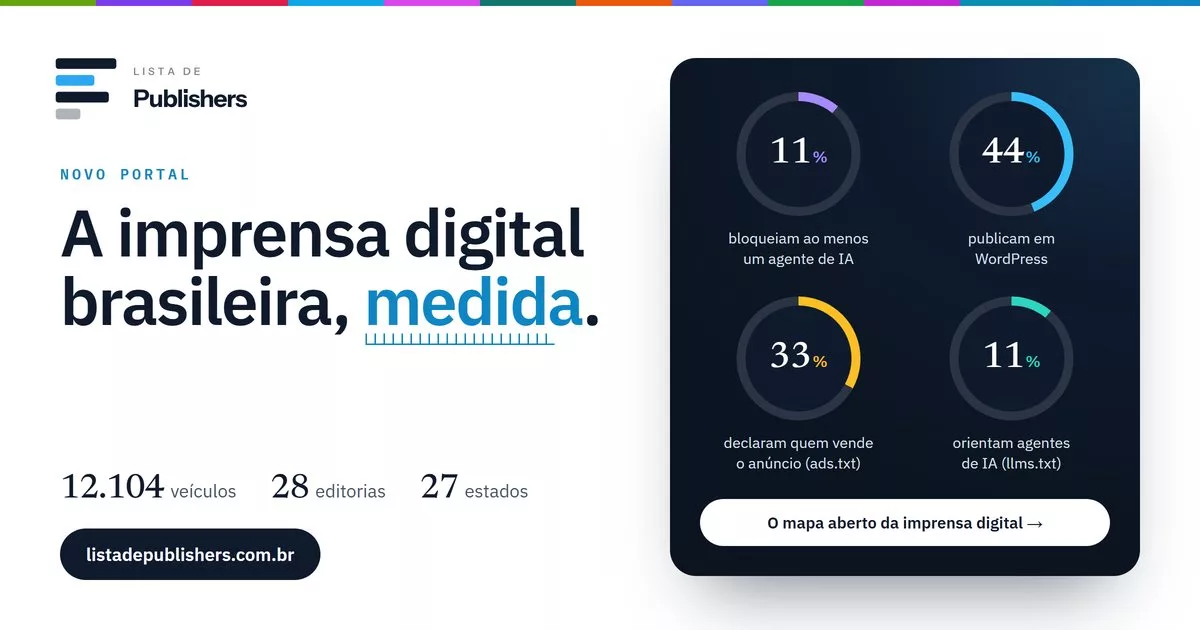
Publishers List is now live, bringing together more than 12,000 outlets across Brazil’s 27 states, classified into 28 editorial categories.
The project sets out to answer a question that has long concerned publishers, advertisers, agencies, and media professionals: who makes up Brazil’s digital press, and how technologically mature are these outlets?
The answer begins with data.
At launch, the portal lists 12,104 outlets, with information organized by editorial category, region, audience, platform, and a range of technical indicators. Users can search for publishers by name, domain, city, or topic and explore the market from different angles.
But the directory is only part of the offering.
A bot that measures publishers’ infrastructure
Publishers List uses automated data collection to technically analyze the outlets in its database.
The system identifies information such as whether a site has a sitemap, RSS, structured data, ads.txt, which technologies it uses, its mobile performance, and settings related to access by artificial intelligence agents.
Among the first findings from its monitoring, 44% of the outlets analyzed use WordPress, while only 33% publish an ads.txt file, a mechanism used to identify companies authorized to sell their advertising inventory.
Another figure stands out: just 11% have an llms.txt file, a resource used to provide AI agents and systems with guidance on the content available on a site. At the same time, 11% of the outlets monitored block at least one of the AI agents tracked by the platform.
These figures help make tangible a discussion that until recently was quite abstract: how technically prepared is the Brazilian press for an environment where an increasing share of information discovery and consumption takes place through AI-based search engines and automated agents?
From audience to digital maturity
The portal also tracks performance and security indicators.
Initial data shows that only 36% of the outlets measured meet the Core Web Vitals criteria, a set of metrics Google uses to assess aspects of the browsing experience. On security, just 2% receive an A+ rating based on the six technical headers monitored by the platform.
The goal is to help each publisher view its infrastructure in a comparative context.
An editorial team can see whether it uses certain technologies, check its performance, and understand how widely these practices have been adopted by other Brazilian outlets.
This creates a layer of market intelligence that would be difficult to build by examining each site individually.
A map of the Brazilian press
The database’s geographic distribution also highlights an important characteristic of the Brazilian market: its strong regional presence.
São Paulo leads with 520 outlets listed in the database, followed by Minas Gerais with 313, Bahia with 310, Paraná with 296, and Rio Grande do Sul with 284. The survey also covers hundreds of outlets in other Brazilian regions and states.
National, state, regional, and municipal press are categorized separately, making it possible to identify outlets that serve specific cities or regions.
For advertisers and agencies, this creates a practical opportunity: to find publishers by editorial category, state, reach, and audience.
For example, an advertiser interested in technology, agribusiness, tourism, or local news can use the database to find outlets that reach that audience and then request contact through the platform.
28 editorial categories for understanding the market by content
Publishers are classified into 28 categories based on the IAB content taxonomy, adapted for Portuguese.
General News accounts for the largest concentration of outlets, followed by Local News. The database also includes publishers specializing in politics, business, sports, technology, health, tourism, entertainment, education, agribusiness, marketing, fashion, and many other verticals.
Classification is not based solely on how an outlet describes itself. The content it publishes is also considered.
This is particularly relevant for media planning, public relations, content distribution, and research on Brazil’s publishing market.
Publishers can join for free
The project offers free listing to publishers.
Publishers not yet listed can request to have their domain added. According to the platform’s rules, there is no charge to be listed, and rankings cannot be bought.
There is also a process for verifying ownership of an outlet. Publishers can supplement or correct their information with proof of ownership and receive a verified outlet badge.
The platform therefore works in two ways.
For publishers, it offers visibility, technical indicators, and opportunities to be discovered by advertisers.
For agencies, brands, and media professionals, it organizes a historically fragmented market and provides a structured research tool.
AI is becoming part of the publishing infrastructure
One of the most interesting aspects of the project is its monitoring of the relationship between publishers and artificial intelligence.
Publishers List tracks which agents can access sites and which are blocked through robots.txt settings.
This information is likely to become increasingly important.
Publishers are beginning to decide which systems can access their content, for what purposes, and under what conditions. At the same time, AI-based answer engines are competing with traditional search engines as intermediaries between information and audiences.
There is no single right strategy for every outlet.
A publisher may choose to restrict a particular crawler for commercial or editorial reasons. Another may decide that allowing access increases its chances of being discovered by new systems.
What was missing was a broader picture of how the Brazilian market is responding.
The platform is beginning to build that picture.
First-party data on the Brazilian market
Another important feature of Publishers List is the methodology used to produce its indicators.
The technical data presented comes from its own collection process, recording what the bot found on sites and the rules used for each classification.
This allows the portal to gradually evolve from a directory into an observatory of the publisher market.
By continuously tracking thousands of sites, it becomes possible to identify trends that would be difficult to spot individually: growing adoption of certain technologies, changes in access for AI agents, performance improvements, use of advertising standards, and differences between segments or regions.
The result is a database that can support recurring studies of Brazil’s digital media infrastructure.
A new piece of the digital market mapping project
Publishers List is part of a family of platforms focused on mapping the Brazilian market, alongside Events List, dedicated to trade shows, conferences, and events, and Agency List, which organizes marketing, communications, and technology companies.
The platform is an initiative of the Instituto da Maturidade Digital and was developed by VitaminaWeb.
There is a clear reason why publishers are one of the project’s areas of focus: thousands of Brazilian outlets take part in producing and distributing information every day, but much of this landscape remains scattered.
Creating a national database makes it possible to begin measuring this market at a level of detail that traditional audience rankings cannot provide.
Audience remains relevant, but it can now be analyzed alongside infrastructure, security, advertising technology, regional presence, performance, and readiness for artificial intelligence agents.
This combination is what could make Publishers List particularly useful.
The portal launches as a directory, but its database makes something more possible: tracking over time how Brazil’s digital press is structured technically and how it responds to the changes reshaping content distribution on the internet.
Publishers List is available at listadepublishers.com.br.


