8 Reasons AI Is Changing Agencies
The traditional agency model is collapsing. Find out why AI, digital maturity, and autonomous agents are redefining strategy, pricing, and value propositions in the digital market.


Over the past few months, I’ve been saying publicly that the digital market isn’t “changing.” It has already changed.
Artificial Intelligence isn’t the problem. It’s just the catalyst.
What’s collapsing is the traditional service delivery model based on manual execution.
Most agencies already understand that AI is part of the game.
What they haven’t fully grasped yet is something far more structural:
We’re witnessing the end of the idea that effort is a value proposition.
Explore the reasons behind the significant changes AI is bringing to agencies.
1. The inevitable compression of value
For decades, the agency model rested on three pillars:
-
Specialized labor
-
Time as a pricing unit
-
Manual production as a differentiator
This model worked because knowledge and access were unevenly distributed.
Today, that gap is disappearing.
According to McKinsey (2024), 76% of global leaders consider AI a strategic priority for the next two years. This means clients themselves are bringing technology, automation, and intelligence in-house.
Meanwhile, the World Economic Forum (Future of Jobs Report 2023) projects that 44% of current skills will change by 2027, with a major impact on operational roles.
The practical takeaway for agencies:
If your value proposition is manual execution, you’re selling something that’s becoming abundant.
And abundance drives prices down.
2. The invisible crisis: CAC rises, conversion falls
Over the past five years, three trends have intensified:
-
A structural rise in acquisition costs
-
Extreme channel fragmentation
-
Content saturation
Gartner (Digital Marketing Survey, 2024) shows that marketing leaders are shifting budgets from production to technology, automation, and data intelligence.
This isn’t a trend. It’s a restructuring.
The problem is no longer the campaign.
The problem is now the architecture.
If a company doesn’t have:
-
Integrated data
-
Structured governance
-
Intelligent automation
-
Predictive models
It doesn’t scale efficiency. It only scales investment.
3. 95% of traffic is anonymous, and that changes everything
Most digital traffic remains unidentified.
The traditional persona-based segmentation model can no longer capture behavior in real time.
According to Salesforce (State of the Connected Customer, 2025):
76% of consumers expect personalized, integrated experiences across channels.
Personalization is no longer a differentiator. It’s become the bare minimum.
But real personalization requires:
-
Data infrastructure
-
System integration
-
Contextual automation
-
Behavior modeling
-
Governance
Without these, there’s no intelligence.
There’s only media.
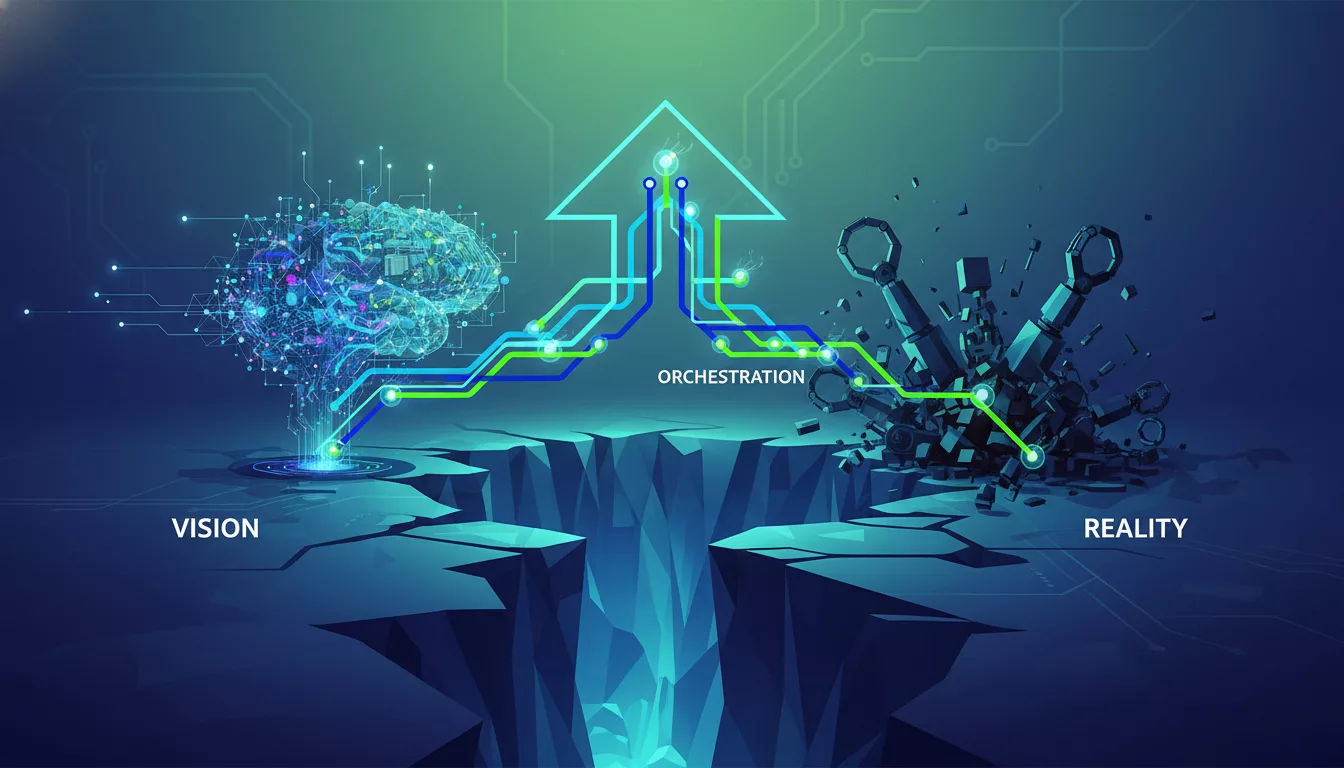
4. The real disruption: from execution to orchestration
We’re entering the age of autonomous agents.
Gartner projects that by 2028:
-
33% of enterprise software will include AI agents
-
15% of daily operational decisions will be made by agents
This changes how the internet works.
Before:
Human → Interface → System
Now:
Agent → API → Structured data → Decision
Value no longer lies in the layout.
It lies in cognitive infrastructure.
Websites are no longer storefronts. They become structured databases for machines to consume.
This shift redefines the role of the agency.
5. Digital Maturity: the real dividing line
Fewer than 5% of Brazilian companies reach advanced stages of digital maturity.
Most still operate with:
-
Fragmented data
-
A culture that isn’t data-driven
-
Limited automation
-
Lack of governance
Yet they still try to scale media.
According to MIT CISR (2024), highly digitally mature companies are three times more likely to outperform their industry’s average growth rate.
The differentiator isn’t the tool.
It’s the ability to align strategy, culture, and technology.
6. The fallacy of AI-driven productivity
The market’s biggest trap is reducing AI to a productivity tool.
AI isn’t about writing posts faster.
It’s about restructuring the business model.
When:
-
Copy is generated in seconds
-
Creative assets are automated
-
Reports are summarized by LLMs
-
Segmentation becomes predictive
The client inevitably asks:
“If I can do 60% of this in-house, what’s the agency’s role?”
If the answer is execution, margins evaporate.
If the answer is:
-
Architecture
-
System integration
-
Contextual intelligence
-
Governance
-
Agent orchestration
-
Data structuring
The agency becomes indispensable.
7. The three forces reshaping the market
Analysis from McKinsey, WEF, and Gartner points to three converging forces:
-
Artificial Intelligence at scale
-
Global demographic shifts
-
Ongoing digital acceleration
The result:
-
More demanding consumers
-
Shorter innovation cycles
-
Pressure to improve operational efficiency
-
The need for mass personalization
This environment doesn’t favor those who execute.
It favors those who build structure.
8. The new model: systemic, not linear
Traditional model:
Brief → Production → Delivery → Invoice
Emerging model:
Data → Infrastructure → AI → Automation → Continuous learning → Recurring value
This shift changes:
-
Pricing
-
Team structure
-
Business model
-
Client relationships
-
Value proposition
We are moving from producing assets to designing intelligence.
What is really at stake
The question is not whether investing in AI is worthwhile.
The question is:
Is your service delivery model ready for a market where execution has become a commodity?
Between 2025 and 2030, the industry will see a significant redistribution of margins.
The biggest agencies won't be the ones to win.
The most adaptable ones will.
The question is not whether the model will change.
It already has.
The final question is:
Is your agency still selling effort, or has it started selling structured intelligence?
The answer will shape your next five years.