Digital Trends and Insights · Artificial Intelligence
Agentic Orchestration: The Gap Between Vision and Reality
This article takes an in-depth look at the findings of the 2026 State of Agentic Orchestration and Automation report, exploring how process complexity is outpacing companies' ability to innovate and why agentic orchestration is emerging not just as a technical solution, but as the new operating model for organizations seeking to transform isolated AI experiments into durable, business-critical capabilities.

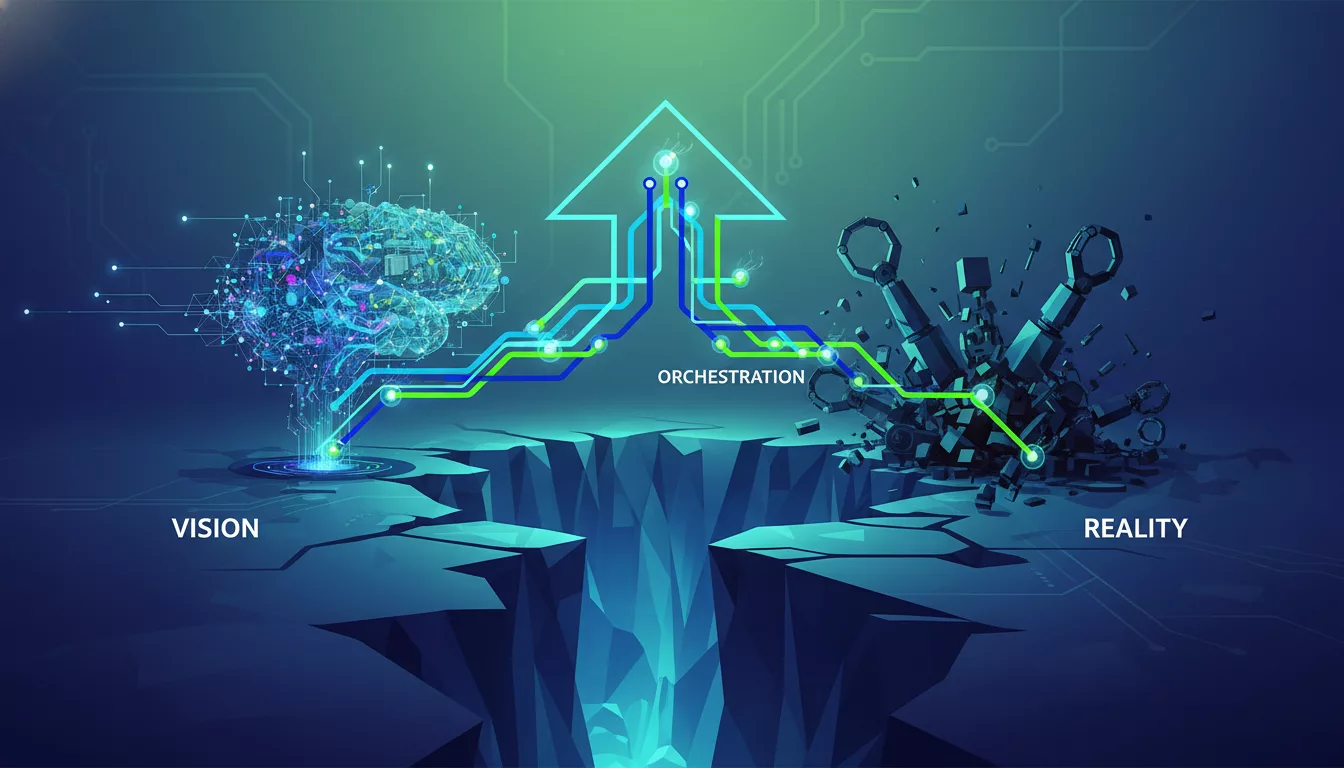
The business automation landscape has reached a critical inflection point. On one side, traditional automation continues to prove its unquestionable value, driving growth and efficiency to unprecedented levels. On the other, the revolutionary promise of Artificial Intelligence (AI), specifically through autonomous agents, is running up against formidable barriers of trust, complexity, and governance.
The "2026 State of Agentic Orchestration & Automation" report, based on a comprehensive survey of 1,150 senior IT and business leaders at organizations with more than 1,000 employees , reveals a fascinating paradox: while AI adoption is widespread, its implementation in critical business processes is still in its early stages.
The adoption paradox: Vision vs. reality
The adoption of AI agents in companies reveals a striking contrast between enthusiastic experimentation and cautious implementation. An AI agent, defined as software that uses Large Language Models (LLMs) to interpret goals, make decisions, reason about next steps, and interact with people, systems, and devices, promises to extend automation to complex knowledge work that previously required human judgment.
However, the data reveals a significant gap. Although 71% of organizations are already using AI agents in some capacity, only 11% of use cases made it into production over the past year. This discrepancy has led 73% of leaders to acknowledge a wide gap between their vision for the use of agentic AI and the current reality of their operations.
Today's adoption pattern reflects a defensive stance. The vast majority (80%) of AI agents currently in operation act as chatbots or assistants focused on summarizing information and answering questions, rather than handling mission-critical cases. They operate at the edges of business processes, relying heavily on human oversight and approval for important decisions.
Nearly half of leaders (48%) admit that their agents operate in silos and are not integrated into end-to-end processes.
The continued success of traditional automation
To understand the urgency of resolving this AI paradox, it is important to recognize the continued success of traditional process automation. Investment in business automation is not just growing, it is delivering tangible results and fueling a voracious appetite for more.
Many people mistake something that is "Automated" for Artificial Intelligence.
An overwhelming 95% of organizations reported business growth from process automation over the past 12 months, a significant jump from 87% the previous year. Organizations have now automated an average of 48% of their processes, and expect that figure to reach 64% in the future.
This proven success is fueling aggressive investment projections. Nearly four in five organizations (79%) plan to increase spending on automation, with budgets expected to rise by an average of 20% over the next two years. An impressive 85% say they will increase automation spending by at least 10%. Automation has already proven its value in essential processes, from customer onboarding and claims processing to order fulfillment and fraud detection.
Complexity becomes a brake on innovation
Despite the success of automation and enthusiasm for AI, organizations are finding that process complexity is growing at a pace that threatens to outstrip their ability to innovate.
As technology stacks evolve, the volume and diversity of process "endpoints" (the points of interaction within a workflow) are increasing exponentially.
The table below details the main sources of this growing complexity:
|
Source of Complexity
|
Reported Impact
|
Description
|
|
Regulatory Complexity
|
81%
|
The need to comply with constantly changing rules and laws.
|
|
Conditional Logic
|
57%
|
Processes that require complex branching and decisions based on multiple variables.
|
|
Legacy Systems
|
54%
|
Difficulty connecting and integrating old infrastructure with new technologies.
|
|
Interoperability
|
47%
|
The challenge of getting multiple different systems to communicate seamlessly.
|
|
Human Work
|
41%
|
Integrating tasks that require human intervention, judgment, or approval.
|
|
In-house Software
|
33%
|
Homegrown solutions that are difficult to integrate with modern platforms.
|
The most common endpoints illustrate the diversity of today’s technology ecosystem: 60% involve enterprise applications such as SAP, Oracle and Salesforce; 56% use task automation technologies such as RPA; and 50% already incorporate AI/ML software, including LLMs and intelligent document processing (IDP) tools.
Creating or changing an end-to-end process often means touching multiple systems and interfaces, which slows change and increases risk. It’s no surprise that 85% of leaders say they need better tools to manage process intersections, and 66% are looking for more effective ways to monitor and control automation .
The risk of uncontrolled AI. How far can we trust it?
If complexity is the structural brake, lack of trust is the psychological and governance barrier that keeps AI from taking on a central role. Organizations understand that AI can deliver substantial value, but trust remains the main obstacle to wider adoption in critical processes.
The research identified deep, systemic concerns about AI implementation:
|
Trust Barrier
|
Frequency
|
Main Implication
|
|
Business Risk
|
84%
|
Concern about using AI in day-to-day processes when IT lacks appropriate controls.
|
|
Lack of Transparency
|
80%
|
Uncertainty about how AI makes decisions within business processes (the "black box" problem).
|
|
Compliance
|
66%
|
Regulatory and legal concerns surrounding the use of autonomous agents.
|
|
Skills Gap
|
56%
|
Lack of in-house skills to manage AI effectively and safely.
|
|
Error Amplification
|
50%
|
Fear that AI will make poorly implemented processes even worse.
|
|
Doubts About Value
|
42%
|
Questions about the usefulness of using agentic AI where it adds no clear value.
|
|
Critical Delegation
|
39%
|
Fundamental lack of trust in delegating mission-critical tasks to AI.
|
Half of respondents (50%) explicitly believe that the risks of "untamed" agentic AI could fan the flames of poorly implemented processes and automations. This cautious stance is understandable, but it carries its own strategic risk: organizations that cannot move beyond pilots and isolated use cases will capture only a fraction of AI's potential value.
Agentic Orchestration: The New Operating Model
The solution to the impasse between the need for advanced automation and the fear of uncontrolled AI lies in "agentic orchestration." This concept represents a paradigm shift, moving from siloed agents to a model where agents, people, and systems are orchestrated as part of end-to-end governed business processes.
Agentic orchestration enables teams to combine deterministic orchestration (clear rules, defined paths) with dynamic orchestration (AI's adaptive reasoning). It uses agents to add dynamic reasoning to deterministic processes, allowing them to adapt in real time while always staying within safe boundaries.
To build a foundation of trust for AI agents in production, agentic orchestration provides an essential control layer. This means:
- Deterministic Process Models: Clearly define where agents are allowed to act.
- Clear Guardrails: Establish strict limits on agent behavior.
- Human-in-the-loop Intervention: Determine which decisions require mandatory human approval.
- Uncertainty Management: Define clear protocols for what to do when AI confidence scores are low.
- Observability and Auditing: Capture a complete and transparent audit trail of every step an agent takes.
Currently, only 10% of organizations say they are using agentic orchestration. The vast majority (85%) acknowledge that they have not yet reached the level of process maturity needed to implement it. However, the urgency is clear: 81% say that without agentic orchestration, achieving a fully autonomous enterprise is an "impossible dream".
Where is the future of AI headed?
Business leaders are remarkably aligned on the way forward. An overwhelming majority of 90% say AI needs to be orchestrated like any other endpoint within automated business processes to ensure compliance with regulations . In addition, 88% agree that AI must be orchestrated across business processes to get the most out of their investment.
Business process maturity is essential to safely implement agentic orchestration at scale. Organizations need to increase their process maturity and AI maturity in parallel. As agents become more capable, teams must be ready to incorporate them into end-to-end governed processes rather than bolt them onto fragile or ad hoc automations.
Once this foundation of trust is in place, agents stop being isolated copilots or chatbots and become powerful endpoints within a governed process. This is agentic orchestration in practice: the ability to design, orchestrate, and govern enterprise-grade agents that handle business-critical work.
Organizations are under immense pressure to automate what matters most by safely embedding AI agents in the core processes they use to build and sell their products and services. Agentic orchestration, not isolated autonomous agents, is the key to closing the gap between the vision and reality of AI. By using deterministic process models, clear boundaries, and event-driven orchestration to coordinate agents, people, systems, and devices, companies can build a foundation for AI agents they can truly trust.
This is how organizations will turn today's AI experiments into tomorrow's durable, business-critical capabilities.